When Calgary, Alberta’s SkyFire Energy Inc. announced its acquisition of Hakai Energy Solutions, headquartered in Cumberland, British Columbia, the transaction not only expanded SkyFire Energy’s solar EPC (Engineering, Procurement, and Construction) reach across Western Canada, it also bolstered SkyFire Energy’s unique employee-owned business model which CEO and President, David Vonesch, explains, is central to how the company defines itself as a business.
“We launched our broad-based employee ownership model here at SkyFire in 2018 and we now have 56 employee owners across five different locations in Western Canada,” says Vonesch, who joined the ownership team in 2010. “We’re locally owned in all the markets in which we operate and that’s been a key part of our success because it’s those individuals who are on a client’s roof or maintaining their utility scale solar farm or managing their project who exemplify our business. If you’re a client, you will likely be dealing with an employee owner at some point during the life cycle of your project. Our team members take a lot of pride in that and the success of the client’s project is very much tied to their success in a lot of ways. It’s definitely a differentiator for SkyFire.”
“We have inherited those rough and tumble roots – our leadership team has been in the shoes of our field staff. And I think it’s foundational for why we wanted to build an employee-owned business.“
In practical terms, the employees are engaged formally every quarter, according to Vonesch, who says quarterly discussions take place after the financials are disclosed, where the employee owners take part in brainstorming sessions as they dive into challenges or opportunities. “We’ll discuss paid sick day policies to Christmas bonuses to operational challenges and everything in between,” he says. “In addition, we’ll gather every couple of years for a major strategy session to review the vision that is being established by the executive team here at SkyFire Energy to make sure there’s alignment throughout the organization.”
Vonesch feels this philosophy of instilling an owner’s mindset within an employee makes a significant difference in the overall operating atmosphere of the company country-wide. If an individual installing fasteners on a customer’s roof or providing any other services, has a direct stake financially, even if it’s a small stake, that thread is important for the broad-based ownership model and how it impacts the company’s delivery and customer service.
For Vonesch, that employee-owner connection is very personal. As the third employee after Dave Kelly founded the company in 2001, he says the early days of that industry were quite humble because there weren’t a lot of opportunities for running a solar business in the province of Alberta. “One day you would be selling a project, the next day selling project management and the day after, you would be on the roof doing the actual solar installment,” he says. “So, we have inherited those rough and tumble roots – our leadership team has been in the shoes of our field staff. And I think it’s foundational for why we wanted to build an employee-owned business.”
From those modest beginnings in the early 2000s, SkyFire Energy has diversified across numerous sectors, from working with residential home builders at volume, to residential retrofit, to commercial and industrial behind the-meter-projects, to building large ground-mounted utility scale projects that are directly connected to the grid.
Scaling up
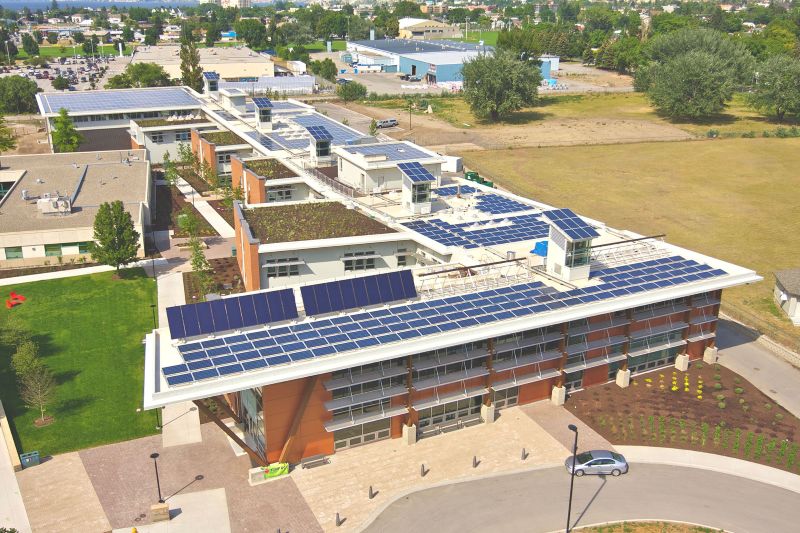
In 2011, SkyFire Energy took a huge step with its completion of the power supply for Okanagan College’s Jim Pattison Centre of Excellence in Penticton, British Columbia. It was the company’s largest project at an output of 260 kW and one of Western Canada’s largest solar energy systems at the time. Its 1,106 solar power panels send excess electricity to the grid during the summer and the system picks up power from the grid during the winter. Of note, is the fact that electrical apprentices from the college gained practical experience with hands-on installation experience.
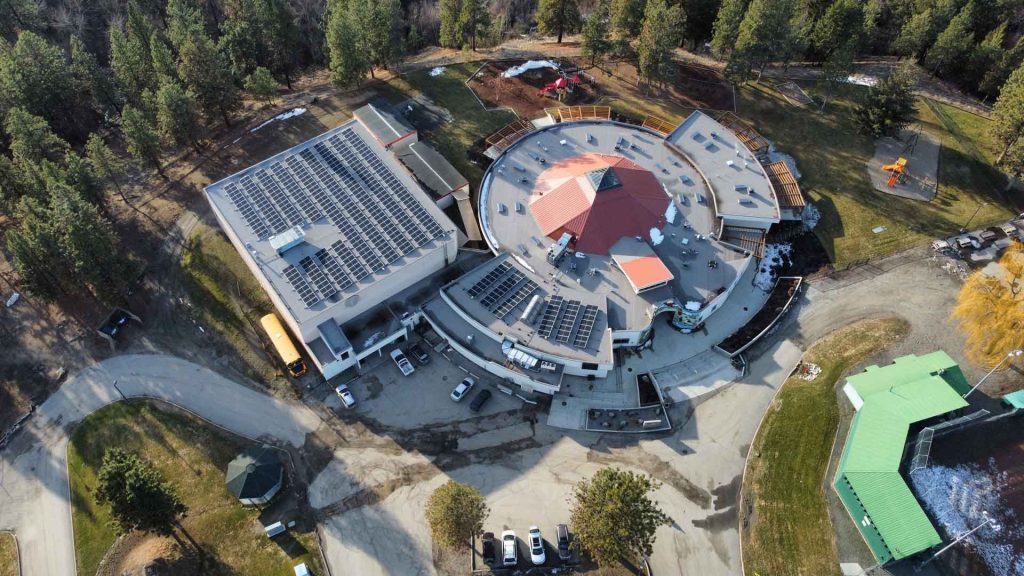
That experience, says Vonesch, helped the company launch into bigger and better opportunities such as the 1.05 MWp Teck SunMine project at Kimberley, B.C., the 1.2 MWp Sundancer project at Maskwacis, Alberta, the 2 MWp Green Acres Colony project at Bassano, Alberta, the 13.7MWp Alberta Solar One Project at Burdett, the 101 MWp Saddlebrook Solar project at Aldersyde, Alberta and numerous other scaled up projects. The Okanagan project and the others that soon followed were developed based on economics as the key driver.
The business case
Depending upon the sector and location, there are varying reasons, of course, as to why individuals and companies choose to install solar power. In terms of the economics, the business case might be considered from a longer-term outlook, for example, 10 plus years. But even in the short term, solar can represent the lowest cost of energy produced for that facility. This represents a noticeable shift from when SkyFire Energy entered the sector in the early 2000s and there was really no economic case for solar installation except possibly for off-the-grid SCADA systems and remote applications where there was no other power source.
In the current environment, especially in a province such as Alberta, solar power for residential or commercial buildings, whether rooftop or ground-mounted, makes strong economic sense for many individuals and businesses says Vonesch. “This has been proven here in Alberta where we have a deregulated market,” he says. “So, it’s private investors making private decisions about how to invest in a market where the price of electricity is determined by supply and demand. We’ve seen projects valued at a billion dollars move forward and get built in this province without any incentives because of the economic case, purely on a market basis. Now we’re seeing where other regulated utilities and other jurisdictions are taking note of that and looking to procure more solar at all scales.”
Vonesch does point out that there are also tax incentives available in various provincial and municipal jurisdictions as well as from the Canadian federal government’s suite of Clean Technology Investment Tax Credits, which give refundable credits of up to 30% of eligible solar project costs, on top of accelerated tax depreciation. Those tax credits are a significant boost for projects in that space to move forward based on the economics since they improve the return on investment.
Growth strategy
SkyFire Energy’s consistent and solid growth over this past quarter century has allowed it to pursue various other business opportunities. For instance, the acquisition of Hakai Energy Solutions on Vancouver Island is SkyFire Energy’s third acquisition. Hakai Energy installs both residential and commercial grid-type systems, including off-grid, micro-grid, solar and battery storage projects on the British Columbia coast, in remote areas of Vancouver Island and coastal B.C.
SkyFire Energy had previously expanded into Edmonton, Alberta and Kelowna, B.C. through a similar model of partnering with, or merging with, long tenured solar contractors whose business models aligned with SkyFire Energys model. It is the largest acquisition so far for the company and adds to its geographical diversification. “That diversification is a real strength for us,” Vonesch says. “This allows us to be at the headwinds for specific opportunities or markets at specific moments. It’s also a point of resiliency for our customers – trusting that we will be there for them in the long term for our warranties. So, we’re going to continue to lean into that strategy of diversification, to lean further into the employee ownership model and thirdly, as the third tenet of our vision and strategy, to lean into our values-based approach to our business.” All photos courtesy of SkyFire Energy Inc.