
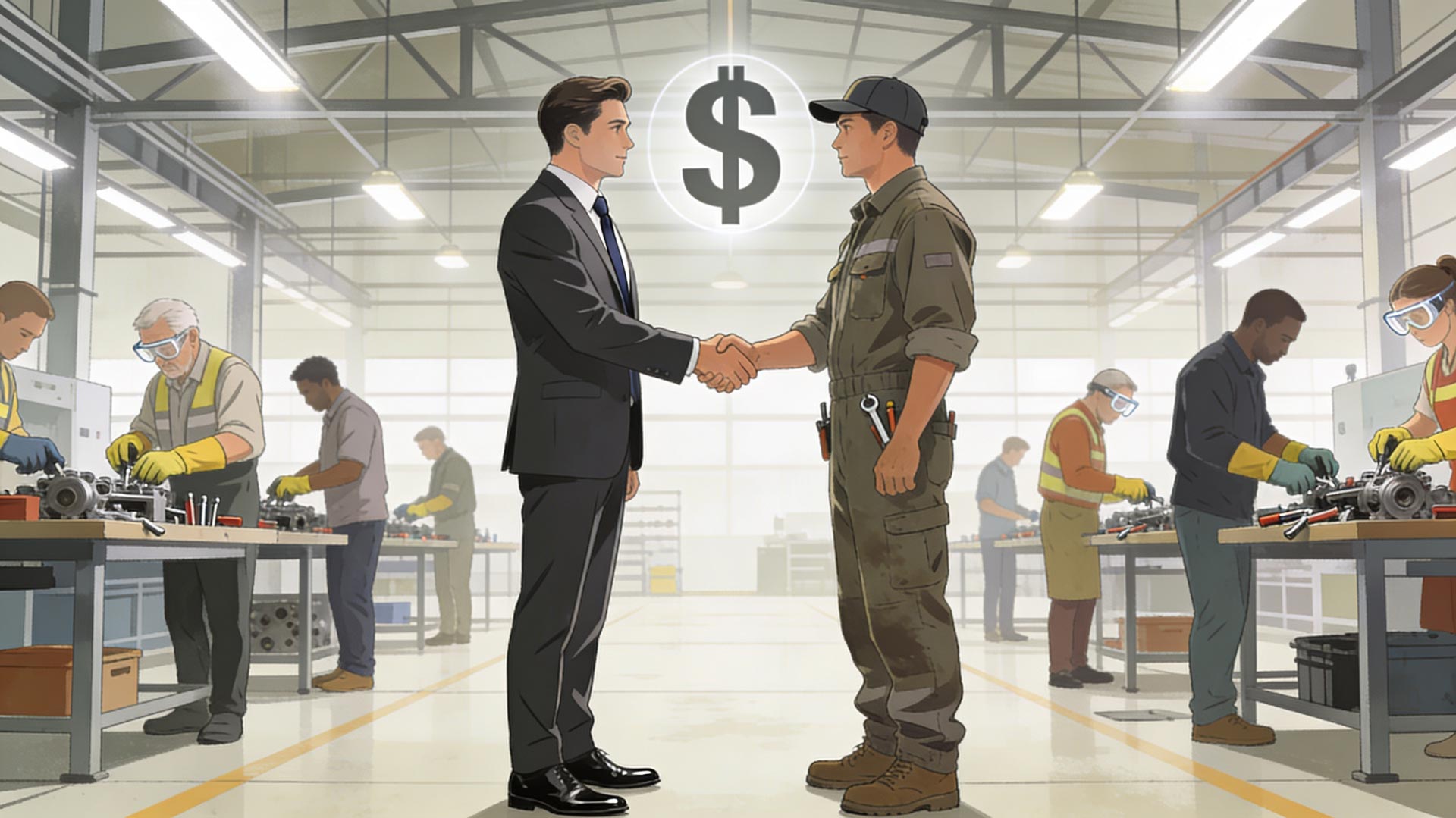
Across North America, vast wealth and local jobs sit inside companies run by owners in their late-fifties to early-seventies. Many started in the 1980s or 1990s with a truck, a toolbox, or a professional licence, and turned that into something real: crews, offices, clients, a name people know.
They also tend to carry the same exit plan in their heads.
“I will sell in a few years when I am ready.”
“Some day, I will hand this to the kids or a key employee.”
It is a tidy story. There is an invisible buyer waiting. The price will be “enough.” The transition will be civilized. The owner will finally have time to travel, golf, or just sleep in without being woken by the ring of a phone.
The problem is not that this story is impossible. It is that, for a lot of owners, it is only a story.
Underneath it are a few big assumptions:
- That there will be a buyer you like, when you happen to be ready
- That this buyer will pay roughly the number in your head
- That staff, customers, spouse, and bank will all be fine with how it plays out
When you look at the data and at what actually happens to real companies, the picture is less tidy.
Some day, I will hand this to the kids or a key employee. It is a tidy story. When you look at the data and at what actually happens to real companies, the picture is less tidy.

A demographic wave, not a headline gimmick
In 2022, the Canadian Federation of Independent Business (CFIB) asked small business owners about their plans. About 76% said they expected to exit their business within the next 10 years. The estimated value of those businesses was more than $2 trillion.¹
In the same research, only about 9% of owners said they had a formal, written succession plan.² The BC Chamber of Commerce has flagged a similar gap for family businesses: roughly three-quarters do not have what most people would recognise as a robust, documented, and communicated succession plan.³
South of the border, the pattern looks familiar. Analysts estimate that baby boomers own about 40% of U.S. small businesses, and fewer than a third of those owners have a succession plan.⁴ ⁵ Different country, same basic equation: a lot of older owners, a lot of private wealth, not much written down.
Put that together and the “Silver Tsunami” label stops sounding like a consultant’s slide and starts looking like basic arithmetic. Over the next decade, millions of owner-managed firms across North America will have to be sold, handed down, or quietly shut. Most are run by people in their sixties. Most of those people do not yet have a detailed, tested plan for what happens after them.
That does not mean everyone is doomed. Many owners do manage a clean sale or handover. What it does mean is that a lot of people are making retirement-scale bets on the future of their business without putting in the groundwork buyers, lenders, or successors will look for when it is their money on the line.
Why so many exits fall short
You might expect, by now, that someone would have built a clean Canadian database showing how many small businesses go to market, how many sell, and on what terms. That database does not exist. What we have instead are partial views, and all of them point in the same direction.
U.S. industry sources suggest that a large share of listed small businesses never actually sell and that many end up being wound down or closed instead.⁶ The exact percentage is argued about, but nobody claims it is a minor issue. In Canada, you hear the same story from transaction lawyers, brokers, bankers, and owners who have tried to sell once and come back bruised.
When Canadian owners are asked what stands between them and a successful transition, three themes show up again and again.³ ⁷ They struggle to find a buyer they trust. They cannot get comfortable with the price on offer. They discover, often late, that the business still depends heavily on them for sales, pricing, key relationships, and general “keeping the wheels on.”
On the buyer side, it is not obvious who will absorb this wave of firms. Younger entrepreneurs often prefer to build their own company, with their own systems and culture. Corporate and private-equity buyers are choosy. They look for clean, understandable financials, a diversified customer base, and a leadership team that can run the place without the founder in every meeting.
On the family side, the numbers are not kind either. Long-run studies across multiple countries show that only about 30% of family businesses make it to the second generation, roughly 10–15% to the third, and only a small fraction beyond that.⁸ The rest are sold, merged, or closed. A smooth handover to the next generation happens, but it is not the norm.
Underneath all of this is a simpler problem. Most owner-managed firms were built for performance under the current owner, not for transferability. Key customers deal directly with the founder. Pricing decisions land on their desk. Staff know that if things get bad enough, the owner will step in and fix it.
That hands-on style can be a real advantage in the growth years. It is less charming when a buyer, lender, or successor starts asking what happens if that person is not around.
What a failed or forced exit looks like
The consequences of weak preparation do not usually show up in a neat chart. They show up in individual businesses that tried to sell and did not like what they found.
Picture a not-unusual case. A 62-year-old owner of a niche manufacturing firm in Canada. Forty employees. The company has been profitable for years. Most of the family’s wealth is tied up in company shares and the building. For a long time, the informal number in the owner’s head has been “three to four times earnings.”
When they finally test the market, a few things become obvious very quickly.
The financial statements are technically correct but hard to interpret. Personal and one-time expenses blur the true earnings. Customer concentration is high. A handful of accounts drive most of the profit. The second-tier managers can run their departments, but only with the owner present and reachable.
Serious buyers do not simply multiply last year’s net income. They normalise the numbers, adjust for risks, and discount for the fact that the operation is still tightly wrapped around one person. Offers, if they come, are below expectations and structured with a significant portion of the price deferred and conditional: vendor financing, earn-outs, and continued involvement from the owner.
The owner and spouse, who had quietly planned for a clean sale and a simple retirement income, now face a more complicated reality. A large part of their future cash flow depends on the performance of a business they no longer fully control.
In other cases, there is no offer at all. A professional practice or contractor goes looking for buyers and finds little serious interest at a price that makes sense. The owner pushes the decision out a year, then another, while age and energy move in the wrong direction and key staff start making their own plans.
These outcomes are rarely the result of a single dramatic mistake. They are usually the result of doing nothing for a long time about problems everyone already knew were there: heavy owner dependence, unclear financials, a thin management layer, and no agreed path for family or staff.
The worst-case scenario: death or incapacity without a plan
There is a harsher version of the story that does not show up in many succession surveys. It is what happens when an owner dies or becomes incapacitated before any exit takes place.
MNP’s work on Canada’s aging entrepreneurs found that nearly two thirds did not have a formal succession plan, even though small and mid-sized firms employ millions of people and generate a significant share of private-sector GDP.⁷ PwC’s family business survey notes that more than half of family businesses globally lack a documented continuity plan for sudden events.² U.S. sources estimate that about three quarters of business owners do not have a written plan for what happens if an owner or senior partner dies or is disabled.³
When that risk becomes reality, the impacts cascade quickly.
If the owner is still the key decision-maker, the first problem is operational. Who can sign cheques. Who has authority to negotiate with banks and landlords. Who takes calls from major customers. If those questions do not have clear answers, staff and counterparties will draw their own conclusions about how safe it is to stay.
The spouse or family is usually left with hard decisions under time pressure. Try to keep the business running without the person who built it. Try to sell in a hurry, often at a discount. Or wind down and salvage what they can. All while dealing with the personal side of the loss.
Employees are forced to decide whether to ride it out or start looking for other work. Customers and suppliers worry about continuity and may quietly start hedging by moving some business elsewhere. Any buyer who appears at that point knows they are dealing with people under stress and short of options.
None of this is inevitable. Continuity planning, insurance, and basic governance can soften the blow if they are put in place early. The snag is that many owners treat mortality and incapacity as private topics, not business risks that can be modelled and managed like any other.
What a robust plan actually does
A realistic succession or exit plan is not a glossy binder that lives on a shelf. It is a set of operational, financial, legal, and personal decisions that move the business from “works because I am here” to “works because of how it is built.”
In practical terms, that usually means:
- Reducing reliance on the owner for sales, pricing, hiring, and problem-solving
- Cleaning up financial reporting so that earnings and cash flow are believable to outsiders
- Spreading customer and supplier risk so the business is not hostage to a handful of relationships
- Building a second layer of leadership that can run the operation without daily rescue from the founder
- Putting basic legal, tax, and continuity structures in place so a transaction or internal transfer is actually executable
None of that is glamorous. It often takes several years. In my experience, owners who work on these issues early are not “getting ready to sell” in the cliché sense. They are buying themselves options.
A business that can run without them gives them more choices. They can sell. They can step back while keeping ownership. They can bring in a partner. They can hand over to family or staff on clearer terms.
Specialist advisors can help with pieces of this. Accountants, lawyers, tax planners, and operational consultants each see part of the picture. People in my role, as an operator and exit-readiness advisor, sit at the intersection: helping owners see what a buyer, lender, or successor would actually think when they look at the business.
Over 25 years and hundreds of cases, one pattern has been consistent. Owners who confront owner-dependence and readiness issues three to five years before they think they “need to” have a much easier set of choices than those who wait until they are already tired and under time pressure.
Questions worth asking now
For any owner in their fifties or sixties, three questions are a useful starting point:
- If I stepped away for three to six months, would this business hold together without constant rescue work from me?
- If my family inherited this business or this level of wealth tomorrow, would they know what to do for the first year?
- If I asked a hard-nosed buyer to walk through the company today, what would they list as the top three risks?
If the honest answers are uncomfortable, that is not a personal failure. It is information. It tells you that your next priority is not another piece of equipment or another contract. It is making sure that when you are finally ready to step back, the people and the business you leave behind will be ready too.
Phil Doublet is the founder of DMC Management Consulting and a business advisor with over 25 years of experience as an entrepreneur, director, C-suite executive, and consultant. He can be reached at phil@phildoublet.com
References
- Canadian Federation of Independent Business. (2022). Succession Tsunami: Preparing for a decade of small business transitions in Canada.
- Canadian Federation of Independent Business. (2022). Over $2 trillion in business assets are at stake as majority of small business owners plan to exit their business over the next decade.
- BC Chamber of Commerce. (2025). Addressing barriers to succession planning for small and medium enterprises.
- Teamshares. (2023). The silver tsunami in small business.
- Gallup. (2024). Small business owners lack succession plan.
- Teamshares. (2023). Succession planning statistics for small business owners.
- MNP. (2023). What Canada’s aging population means for your succession plan.
- CIBC. (2023). The economic case for getting business succession right.